> ## Documentation Index
> Fetch the complete documentation index at: https://auth0-docs-event-stream-action-templates.mintlify.site/llms.txt
> Use this file to discover all available pages before exploring further.

# Ajouter une connexion à votre application React Native

> Ce tutoriel explique comment ajouter la connexion utilisateur à une application React Native à l’aide d’Auth0.

export const LoggedInForm = ({sampleApp}) => {
  const LS_APPS_KEY = "auth_demo_apps";
  const LS_APP_CFG_KEY = "auth_demo_app_cfg";
  const CHANNEL = "auth_flows_sync_v1";
  const mkChannel = () => new BroadcastChannel(CHANNEL);
  function uid() {
    return Math.random().toString(36).slice(2) + Date.now().toString(36);
  }
  function loadApps() {
    const raw = localStorage.getItem(LS_APPS_KEY);
    if (raw) return JSON.parse(raw);
    const seeded = [{
      id: "{yourClientId}",
      name: "Default App"
    }];
    localStorage.setItem(LS_APPS_KEY, JSON.stringify(seeded));
    return seeded;
  }
  function saveApps(apps) {
    localStorage.setItem(LS_APPS_KEY, JSON.stringify(apps));
  }
  function loadCfg() {
    const raw = localStorage.getItem(LS_APP_CFG_KEY);
    return raw ? JSON.parse(raw) : {};
  }
  function saveCfg(cfg) {
    localStorage.setItem(LS_APP_CFG_KEY, JSON.stringify(cfg));
  }
  const RightChevron = ({className = "w-5 h-5", ...props}) => <svg xmlns="http://www.w3.org/2000/svg" viewBox="0 0 24 24" stroke="currentColor" fill="none" strokeWidth="2" strokeLinecap="round" strokeLinejoin="round" className={className} {...props}>
      <polyline points="9 18 15 12 9 6" />
    </svg>;
  const LightningIcon = () => <svg width="24" height="24" viewBox="0 0 48 48" fill="none" xmlns="http://www.w3.org/2000/svg">
      <path fillRule="evenodd" clipRule="evenodd" className="fill-[#3F59E4] dark:fill-[#99A7F1]" d="M24.971 30.152H7.088c-1.786 0-2.745-2.103-1.574-3.453l19.07-21.988c1.33-1.532 3.835-.4 3.569 1.607L24.97 30.152z" />
      <path fillRule="evenodd" clipRule="evenodd" className="fill-[#3F59E4] dark:fill-[#99A7F1]" d="M23.201 17.885h17.885c1.787 0 2.746 2.102 1.575 3.453l-19.073 21.99c-1.33 1.532-3.835.4-3.568-1.607L23.2 17.885z" />
    </svg>;
  const LayersIcon = () => <svg width="24" height="24" viewBox="0 0 48 48" fill="none" xmlns="http://www.w3.org/2000/svg">
      <path className="fill-[#3F59E4] dark:fill-[#99A7F1]" d="M34.54 29.135l6.373 3.183c1.566.782 1.566 3.017 0 3.8l-14.815 7.396a4.623 4.623 0 01-4.125 0L7.174 36.12c-1.565-.782-1.565-3.017 0-3.798l6.532-3.214" />
      <path className="fill-[#AAB6F3] dark:fill-[#3449BA]" d="M34.54 18.86l6.373 3.183c1.566.782 1.566 3.016 0 3.8L26.098 33.24a4.623 4.623 0 01-4.125 0L7.174 25.843c-1.565-.781-1.565-3.016 0-3.798l6.33-3.164" />
      <path className="fill-[#CFD6F8] dark:fill-[#22307C]" d="M21.94 23.058L7.306 15.745c-1.62-.81-1.62-3.123 0-3.932l14.631-7.319a4.693 4.693 0 014.194 0l14.648 7.319c1.622.81 1.62 3.124 0 3.932L26.13 23.058c-1.321.66-2.873.66-4.191 0z" />
    </svg>;
  const GithubIcon = () => <svg xmlns="http://www.w3.org/2000/svg" viewBox="0 0 24 24" fill="none" stroke="currentColor" strokeWidth="2" strokeLinecap="round" strokeLinejoin="round" className="w-5 h-5">
      <path d="M9 19c-5 1.5-5-2.5-7-3m14 6v-3.87a3.37 3.37 0 0 0-.94-2.61c3.14-.35 6.44-1.54 6.44-7A5.44 5.44 0 0 0 20 4.77 5.07 5.07 0 0 0 19.91 1S18.73.65 16 2.48a13.38 13.38 0 0 0-7 0C6.27.65 5.09 1 5.09 1A5.07 5.07 0 0 0 5 4.77a5.44 5.44 0 0 0-1.5 3.78c0 5.42 3.3 6.61 6.44 7A3.37 3.37 0 0 0 9 18.13V22"></path>
    </svg>;
  function IconTile({children}) {
    return <div className="
          shrink-0 grid place-items-center w-10 h-10 rounded-lg
          bg-indigo-50 ring-1 ring-indigo-200/60
          dark:bg-indigo-950/40 dark:ring-white/10
        ">
        {children}
      </div>;
  }
  function Card({className = "", children}) {
    return <div className={`rounded-2xl shadow-sm ring-1 ring-zinc-200 dark:ring-zinc-800 ${className}`}>{children}</div>;
  }
  function Button({variant = "primary", type = "button", onClick, children}) {
    const base = "inline-flex items-center justify-center gap-2 h-10 px-4 rounded-xl font-medium transition";
    let styles = "";
    if (variant === "primary") {
      styles = "mint-bg-indigo-600 text-white hover:mint-bg-indigo-700";
    } else if (variant === "outline") {
      styles = "border border-zinc-300 dark:border-zinc-700 mint-bg-transparent hover:mint-bg-zinc-50 dark:hover:mint-bg-zinc-800";
    } else if (variant === "ghost") {
      styles = "hover:mint-bg-zinc-100 dark:hover:mint-bg-zinc-800";
    }
    return <button type={type} onClick={onClick} className={`${base} ${styles}`}>
        {children}
      </button>;
  }
  function Input({id, label, value, onChange, placeholder, name}) {
    return <label className="block space-y-1">
        <span className="text-sm text-zinc-700 dark:text-zinc-300">{label}</span>
        <input id={id} name={name} className="w-full h-11 px-3 rounded-xl border border-zinc-300 dark:border-zinc-700 bg-white dark:bg-zinc-900 text-zinc-900 dark:text-zinc-100 focus:outline-none focus:ring-2 focus:ring-indigo-500" placeholder={placeholder} value={value} onChange={e => onChange(e.target.value)} />
      </label>;
  }
  function Select({label, value, onChange, options}) {
    return <label className="block space-y-1 max-w-[300px]">
        <span className="text-sm text-zinc-700 dark:text-zinc-300">{label}</span>
        <div className="relative">
          <select className="w-full h-11 appearance-none px-3 pr-9 rounded-xl border border-zinc-300 dark:border-zinc-700 bg-white dark:bg-zinc-900 text-zinc-900 dark:text-zinc-100 focus:outline-none focus:ring-2 focus:ring-indigo-500" value={value} onChange={e => onChange(e.target.value)}>
            <optgroup label="Generic Applications">
              {options.map(o => <option key={o.id} value={o.id}>
                  {o.name}
                </option>)}
            </optgroup>
          </select>
          <svg className="pointer-events-none absolute right-3 top-1/2 -translate-y-1/2 w-5 h-5 text-zinc-500" viewBox="0 0 24 24">
            <path d="M7 10l5 5 5-5z" fill="currentColor" />
          </svg>
        </div>
      </label>;
  }
  function Toast({open, onClose, children}) {
    useEffect(() => {
      if (!open) return;
      const t = setTimeout(onClose, 2200);
      return () => clearTimeout(t);
    }, [open, onClose]);
    return <div className={`fixed right-4 top-4 z-50 transition ${open ? "opacity-100 translate-y-0" : "opacity-0 -translate-y-2 pointer-events-none"}`}>
        <div className="flex items-center gap-2 rounded-xl shadow ring-1 ring-emerald-200 bg-white dark:bg-zinc-900 px-4 py-2">
          <span className="w-1.5 h-8 rounded-l bg-emerald-500" />
          <svg className="w-5 h-5 text-emerald-600" viewBox="0 0 24 24" fill="none" stroke="currentColor" strokeWidth="2">
            <path d="M20 6L9 17l-5-5" />
          </svg>
          <span className="text-sm text-zinc-900 dark:text-zinc-100">{children}</span>
        </div>
      </div>;
  }
  function Flows() {
    const [route, setRoute] = useState("menu");
    const [apps, setApps] = useState(loadApps());
    const [cfg, setCfg] = useState(loadCfg());
    const [selected, setSelected] = useState(apps[0]?.id || "");
    const [toast, setToast] = useState(false);
    const [bc] = useState(() => mkChannel());
    useEffect(() => {
      if (!apps.find(a => a.id === selected)) {
        setSelected(apps[0]?.id || "");
      }
    }, [apps, selected]);
    useEffect(() => {
      const onMsg = e => {
        const {type, payload} = e.data || ({});
        switch (type) {
          case "NAV":
            setRoute(payload.route);
            break;
          case "SELECT":
            setSelected(payload.appId);
            break;
          case "APPS_UPDATED":
            setApps(loadApps());
            break;
          case "CFG_UPDATED":
            setCfg(loadCfg());
            setToast(true);
            break;
          default:
            break;
        }
      };
      bc.addEventListener("message", onMsg);
      return () => bc.removeEventListener("message", onMsg);
    }, [bc]);
    const nav = nextRoute => {
      setRoute(nextRoute);
      bc.postMessage({
        type: "NAV",
        payload: {
          route: nextRoute
        }
      });
    };
    const selectApp = appId => {
      setSelected(appId);
      bc.postMessage({
        type: "SELECT",
        payload: {
          appId
        }
      });
    };
    const onCreate = name => {
      const id = uid();
      const next = [...apps, {
        id,
        name: name || "Untitled"
      }];
      setApps(next);
      saveApps(next);
      bc.postMessage({
        type: "APPS_UPDATED"
      });
      selectApp(id);
      nav("integrate");
    };
    const onSaveCfg = (appId, data) => {
      const next = {
        ...cfg,
        [appId]: data
      };
      setCfg(next);
      saveCfg(next);
      setToast(true);
      bc.postMessage({
        type: "CFG_UPDATED"
      });
    };
    return <div>
        {route === "menu" && <Menu onCreate={() => nav("create")} onIntegrate={() => nav("integrate")} />}

        {route === "create" && <CreateForm onCancel={() => nav("menu")} onSave={onCreate} />}

        {route === "integrate" && <IntegrateForm apps={apps} selected={selected} onSelect={selectApp} saved={cfg[selected]} onSave={data => onSaveCfg(selected, data)} onCancel={() => nav("menu")} />}

        <Toast open={toast} onClose={() => setToast(false)}>
          Successfully saved your changes.
        </Toast>
      </div>;
  }
  function Menu({onCreate, onIntegrate}) {
    return <ul className="space-y-4 list-none login_list">
        <li className="list-none !px-0">
          <button onClick={onCreate} className="w-full text-left">
            <Card className="p-5 hover:shadow-md transition">
              <div className="flex items-center justify-between">
                <div className="flex items-center gap-4">
                  <IconTile>
                    <LightningIcon />
                  </IconTile>
                  <h2 className="text-lg">Create a new application</h2>
                </div>
                <RightChevron className="w-4 h-4 text-zinc-500" />
              </div>
            </Card>
          </button>
        </li>
        <li className="list-none !px-0">
          <button onClick={onIntegrate} className="w-full text-left">
            <Card className="p-5 hover:shadow-md transition">
              <div className="flex items-center justify-between">
                <div className="flex items-center gap-4">
                  <IconTile>
                    <LayersIcon />
                  </IconTile>
                  <h2 className="text-lg">Integrate with an existing application</h2>
                </div>
                <RightChevron className="w-4 h-4 text-zinc-500" />
              </div>
            </Card>
          </button>
        </li>
        <li className="list-none !px-0">
          <a className="no_external_icon block" href={sampleApp ? sampleApp : "/"} target="_blank" rel="noreferrer">
            <Card className="p-5 hover:shadow-md transition">
              <div className="flex items-center justify-between">
                <div className="flex items-center gap-4">
                  <IconTile>
                    <GithubIcon />
                  </IconTile>
                  <h2 className="text-lg">View a sample application</h2>
                </div>
                <RightChevron className="w-4 h-4 text-zinc-500" />
              </div>
            </Card>
          </a>
        </li>
      </ul>;
  }
  function CreateForm({onSave, onCancel}) {
    const [name, setName] = useState("");
    return <div className="space-y-6">
        <Input id="app-name" label="Application Name" placeholder="My App" value={name} onChange={setName} />
        <p className="text-sm text-zinc-500">You can change this later in the application settings.</p>
        <div className="flex gap-3">
          <Button onClick={() => onSave(name)}>Save</Button>
          <Button variant="outline" onClick={onCancel}>
            Cancel
          </Button>
        </div>
      </div>;
  }
  function IntegrateForm({apps, selected, onSelect, saved, onSave, onCancel}) {
    const [callbacks, setCallbacks] = useState(saved?.callbacks ?? "");
    const [logouts, setLogouts] = useState(saved?.logouts ?? "");
    const [origins, setOrigins] = useState(saved?.origins ?? "");
    useEffect(() => {
      setCallbacks(loadCfg()[selected]?.callbacks ?? "");
      setLogouts(loadCfg()[selected]?.logouts ?? "");
      setOrigins(loadCfg()[selected]?.origins ?? "");
    }, [selected]);
    return <div className="space-y-6">
        <div>
          <span className="block text-sm text-zinc-600 dark:text-zinc-300 mb-1">Select your Application</span>
          <Select label="" value={selected} onChange={onSelect} options={apps} />
        </div>

        <form className="space-y-4" onSubmit={e => {
      e.preventDefault();
      onSave({
        callbacks,
        logouts,
        origins
      });
    }}>
          <Input id="callbacks" name="callbacks" label="Callback URLs" placeholder="http://localhost:3000" value={callbacks} onChange={setCallbacks} />
          <Input id="logout" name="allowed_logout_urls" label="Logout URLs" placeholder="http://localhost:3000" value={logouts} onChange={setLogouts} />
          <Input id="origins" name="web_origins" label="Allowed Web Origins" placeholder="http://localhost:3000" value={origins} onChange={setOrigins} />

          <div className="flex gap-3 pt-2">
            <Button type="submit">Save</Button>
            <Button variant="outline" type="button" onClick={onCancel}>
              Cancel
            </Button>
          </div>
        </form>
      </div>;
  }
  return <div className="w-full mx-auto py-8">
      <Flows />
    </div>;
};

export const SignUpForm = () => {
  const [isAuthenticated, setIsAuthenticated] = useState(false);
  const [storeReady, setStoreReady] = useState(false);
  useEffect(() => {
    let unsubscribe = null;
    function init() {
      setStoreReady(true);
      unsubscribe = window.autorun(() => {
        const authenticated = window.rootStore?.sessionStore?.isAuthenticated || false;
        setIsAuthenticated(authenticated);
      });
    }
    if (window.rootStore) {
      init();
    } else {
      window.addEventListener("adu:storeReady", init);
    }
    return () => {
      window.removeEventListener("adu:storeReady", init);
      unsubscribe?.();
    };
  }, []);
  function LoggedInForm({sampleApp}) {
    const LS_APPS_KEY = "auth_demo_apps";
    const LS_APP_CFG_KEY = "auth_demo_app_cfg";
    const CHANNEL = "auth_flows_sync_v1";
    const mkChannel = () => new BroadcastChannel(CHANNEL);
    function uid() {
      return Math.random().toString(36).slice(2) + Date.now().toString(36);
    }
    function loadApps() {
      const raw = localStorage.getItem(LS_APPS_KEY);
      if (raw) return JSON.parse(raw);
      const seeded = [{
        id: "{yourClientId}",
        name: "Default App"
      }];
      localStorage.setItem(LS_APPS_KEY, JSON.stringify(seeded));
      return seeded;
    }
    function saveApps(apps) {
      localStorage.setItem(LS_APPS_KEY, JSON.stringify(apps));
    }
    function loadCfg() {
      const raw = localStorage.getItem(LS_APP_CFG_KEY);
      return raw ? JSON.parse(raw) : {};
    }
    function saveCfg(cfg) {
      localStorage.setItem(LS_APP_CFG_KEY, JSON.stringify(cfg));
    }
    const RightChevron = ({className = "w-5 h-5", ...props}) => <svg xmlns="http://www.w3.org/2000/svg" viewBox="0 0 24 24" stroke="currentColor" fill="none" strokeWidth="2" strokeLinecap="round" strokeLinejoin="round" className={className} {...props}>
        <polyline points="9 18 15 12 9 6" />
      </svg>;
    const LightningIcon = () => <svg width="24" height="24" viewBox="0 0 48 48" fill="none" xmlns="http://www.w3.org/2000/svg">
        <path fillRule="evenodd" clipRule="evenodd" className="fill-[#3F59E4] dark:fill-[#99A7F1]" d="M24.971 30.152H7.088c-1.786 0-2.745-2.103-1.574-3.453l19.07-21.988c1.33-1.532 3.835-.4 3.569 1.607L24.97 30.152z" />
        <path fillRule="evenodd" clipRule="evenodd" className="fill-[#3F59E4] dark:fill-[#99A7F1]" d="M23.201 17.885h17.885c1.787 0 2.746 2.102 1.575 3.453l-19.073 21.99c-1.33 1.532-3.835.4-3.568-1.607L23.2 17.885z" />
      </svg>;
    const LayersIcon = () => <svg width="24" height="24" viewBox="0 0 48 48" fill="none" xmlns="http://www.w3.org/2000/svg">
        <path className="fill-[#3F59E4] dark:fill-[#99A7F1]" d="M34.54 29.135l6.373 3.183c1.566.782 1.566 3.017 0 3.8l-14.815 7.396a4.623 4.623 0 01-4.125 0L7.174 36.12c-1.565-.782-1.565-3.017 0-3.798l6.532-3.214" />
        <path className="fill-[#AAB6F3] dark:fill-[#3449BA]" d="M34.54 18.86l6.373 3.183c1.566.782 1.566 3.016 0 3.8L26.098 33.24a4.623 4.623 0 01-4.125 0L7.174 25.843c-1.565-.781-1.565-3.016 0-3.798l6.33-3.164" />
        <path className="fill-[#CFD6F8] dark:fill-[#22307C]" d="M21.94 23.058L7.306 15.745c-1.62-.81-1.62-3.123 0-3.932l14.631-7.319a4.693 4.693 0 014.194 0l14.648 7.319c1.622.81 1.62 3.124 0 3.932L26.13 23.058c-1.321.66-2.873.66-4.191 0z" />
      </svg>;
    const GithubIcon = () => <svg xmlns="http://www.w3.org/2000/svg" viewBox="0 0 24 24" fill="none" stroke="currentColor" strokeWidth="2" strokeLinecap="round" strokeLinejoin="round" className="w-5 h-5">
        <path d="M9 19c-5 1.5-5-2.5-7-3m14 6v-3.87a3.37 3.37 0 0 0-.94-2.61c3.14-.35 6.44-1.54 6.44-7A5.44 5.44 0 0 0 20 4.77 5.07 5.07 0 0 0 19.91 1S18.73.65 16 2.48a13.38 13.38 0 0 0-7 0C6.27.65 5.09 1 5.09 1A5.07 5.07 0 0 0 5 4.77a5.44 5.44 0 0 0-1.5 3.78c0 5.42 3.3 6.61 6.44 7A3.37 3.37 0 0 0 9 18.13V22"></path>
      </svg>;
    function IconTile({children}) {
      return <div className="
            shrink-0 grid place-items-center w-10 h-10 rounded-lg
            bg-indigo-50 ring-1 ring-indigo-200/60
            dark:bg-indigo-950/40 dark:ring-white/10
          ">
          {children}
        </div>;
    }
    function Card({className = "", children}) {
      return <div className={`rounded-2xl shadow-sm ring-1 ring-zinc-200 dark:ring-zinc-800 ${className}`}>{children}</div>;
    }
    function Button({variant = "primary", type = "button", onClick, children}) {
      const base = "inline-flex items-center justify-center gap-2 h-10 px-4 rounded-xl font-medium transition";
      let styles = "";
      if (variant === "primary") {
        styles = "mint-bg-indigo-600 text-white hover:mint-bg-indigo-700";
      } else if (variant === "outline") {
        styles = "border border-zinc-300 dark:border-zinc-700 mint-bg-transparent hover:mint-bg-zinc-50 dark:hover:mint-bg-zinc-800";
      } else if (variant === "ghost") {
        styles = "hover:mint-bg-zinc-100 dark:hover:mint-bg-zinc-800";
      }
      return <button type={type} onClick={onClick} className={`${base} ${styles}`}>
          {children}
        </button>;
    }
    function Input({id, label, value, onChange, placeholder, name}) {
      return <label className="block space-y-1">
          <span className="text-sm text-zinc-700 dark:text-zinc-300">{label}</span>
          <input id={id} name={name} className="w-full h-11 px-3 rounded-xl border border-zinc-300 dark:border-zinc-700 bg-white dark:bg-zinc-900 text-zinc-900 dark:text-zinc-100 focus:outline-none focus:ring-2 focus:ring-indigo-500" placeholder={placeholder} value={value} onChange={e => onChange(e.target.value)} />
        </label>;
    }
    function Select({label, value, onChange, options}) {
      return <label className="block space-y-1 max-w-[300px]">
          <span className="text-sm text-zinc-700 dark:text-zinc-300">{label}</span>
          <div className="relative">
            <select className="w-full h-11 appearance-none px-3 pr-9 rounded-xl border border-zinc-300 dark:border-zinc-700 bg-white dark:bg-zinc-900 text-zinc-900 dark:text-zinc-100 focus:outline-none focus:ring-2 focus:ring-indigo-500" value={value} onChange={e => onChange(e.target.value)}>
              <optgroup label="Generic Applications">
                {options.map(o => <option key={o.id} value={o.id}>
                    {o.name}
                  </option>)}
              </optgroup>
            </select>
            <svg className="pointer-events-none absolute right-3 top-1/2 -translate-y-1/2 w-5 h-5 text-zinc-500" viewBox="0 0 24 24">
              <path d="M7 10l5 5 5-5z" fill="currentColor" />
            </svg>
          </div>
        </label>;
    }
    function Toast({open, onClose, children}) {
      useEffect(() => {
        if (!open) return;
        const t = setTimeout(onClose, 2200);
        return () => clearTimeout(t);
      }, [open, onClose]);
      return <div className={`fixed right-4 top-4 z-50 transition ${open ? "opacity-100 translate-y-0" : "opacity-0 -translate-y-2 pointer-events-none"}`}>
          <div className="flex items-center gap-2 rounded-xl shadow ring-1 ring-emerald-200 bg-white dark:bg-zinc-900 px-4 py-2">
            <span className="w-1.5 h-8 rounded-l bg-emerald-500" />
            <svg className="w-5 h-5 text-emerald-600" viewBox="0 0 24 24" fill="none" stroke="currentColor" strokeWidth="2">
              <path d="M20 6L9 17l-5-5" />
            </svg>
            <span className="text-sm text-zinc-900 dark:text-zinc-100">{children}</span>
          </div>
        </div>;
    }
    function Flows() {
      const [route, setRoute] = useState("menu");
      const [apps, setApps] = useState(loadApps());
      const [cfg, setCfg] = useState(loadCfg());
      const [selected, setSelected] = useState(apps[0]?.id || "");
      const [toast, setToast] = useState(false);
      const [bc] = useState(() => mkChannel());
      useEffect(() => {
        if (!apps.find(a => a.id === selected)) {
          setSelected(apps[0]?.id || "");
        }
      }, [apps, selected]);
      useEffect(() => {
        const onMsg = e => {
          const {type, payload} = e.data || ({});
          switch (type) {
            case "NAV":
              setRoute(payload.route);
              break;
            case "SELECT":
              setSelected(payload.appId);
              break;
            case "APPS_UPDATED":
              setApps(loadApps());
              break;
            case "CFG_UPDATED":
              setCfg(loadCfg());
              setToast(true);
              break;
            default:
              break;
          }
        };
        bc.addEventListener("message", onMsg);
        return () => bc.removeEventListener("message", onMsg);
      }, [bc]);
      const nav = nextRoute => {
        setRoute(nextRoute);
        bc.postMessage({
          type: "NAV",
          payload: {
            route: nextRoute
          }
        });
      };
      const selectApp = appId => {
        setSelected(appId);
        bc.postMessage({
          type: "SELECT",
          payload: {
            appId
          }
        });
      };
      const onCreate = name => {
        const id = uid();
        const next = [...apps, {
          id,
          name: name || "Untitled"
        }];
        setApps(next);
        saveApps(next);
        bc.postMessage({
          type: "APPS_UPDATED"
        });
        selectApp(id);
        nav("integrate");
      };
      const onSaveCfg = (appId, data) => {
        const next = {
          ...cfg,
          [appId]: data
        };
        setCfg(next);
        saveCfg(next);
        setToast(true);
        bc.postMessage({
          type: "CFG_UPDATED"
        });
      };
      return <div>
          {route === "menu" && <Menu onCreate={() => nav("create")} onIntegrate={() => nav("integrate")} />}

          {route === "create" && <CreateForm onCancel={() => nav("menu")} onSave={onCreate} />}

          {route === "integrate" && <IntegrateForm apps={apps} selected={selected} onSelect={selectApp} saved={cfg[selected]} onSave={data => onSaveCfg(selected, data)} onCancel={() => nav("menu")} />}

          <Toast open={toast} onClose={() => setToast(false)}>
            Successfully saved your changes.
          </Toast>
        </div>;
    }
    function Menu({onCreate, onIntegrate}) {
      return <ul className="space-y-4 list-none login_list">
          <li className="list-none !px-0">
            <button onClick={onCreate} className="w-full text-left">
              <Card className="p-5 hover:shadow-md transition">
                <div className="flex items-center justify-between">
                  <div className="flex items-center gap-4">
                    <IconTile>
                      <LightningIcon />
                    </IconTile>
                    <h2 className="text-lg">Create a new application</h2>
                  </div>
                  <RightChevron className="w-4 h-4 text-zinc-500" />
                </div>
              </Card>
            </button>
          </li>
          <li className="list-none !px-0">
            <button onClick={onIntegrate} className="w-full text-left">
              <Card className="p-5 hover:shadow-md transition">
                <div className="flex items-center justify-between">
                  <div className="flex items-center gap-4">
                    <IconTile>
                      <LayersIcon />
                    </IconTile>
                    <h2 className="text-lg">Integrate with an existing application</h2>
                  </div>
                  <RightChevron className="w-4 h-4 text-zinc-500" />
                </div>
              </Card>
            </button>
          </li>
          <li className="list-none !px-0">
            <a className="no_external_icon block" href={sampleApp ? sampleApp : "/"} target="_blank" rel="noreferrer">
              <Card className="p-5 hover:shadow-md transition">
                <div className="flex items-center justify-between">
                  <div className="flex items-center gap-4">
                    <IconTile>
                      <GithubIcon />
                    </IconTile>
                    <h2 className="text-lg">View a sample application</h2>
                  </div>
                  <RightChevron className="w-4 h-4 text-zinc-500" />
                </div>
              </Card>
            </a>
          </li>
        </ul>;
    }
    function CreateForm({onSave, onCancel}) {
      const [name, setName] = useState("");
      return <div className="space-y-6">
          <Input id="app-name" label="Application Name" placeholder="My App" value={name} onChange={setName} />
          <p className="text-sm text-zinc-500">You can change this later in the application settings.</p>
          <div className="flex gap-3">
            <Button onClick={() => onSave(name)}>Save</Button>
            <Button variant="outline" onClick={onCancel}>
              Cancel
            </Button>
          </div>
        </div>;
    }
    function IntegrateForm({apps, selected, onSelect, saved, onSave, onCancel}) {
      const [callbacks, setCallbacks] = useState(saved?.callbacks ?? "");
      const [logouts, setLogouts] = useState(saved?.logouts ?? "");
      const [origins, setOrigins] = useState(saved?.origins ?? "");
      useEffect(() => {
        setCallbacks(loadCfg()[selected]?.callbacks ?? "");
        setLogouts(loadCfg()[selected]?.logouts ?? "");
        setOrigins(loadCfg()[selected]?.origins ?? "");
      }, [selected]);
      return <div className="space-y-6">
          <div>
            <span className="block text-sm text-zinc-600 dark:text-zinc-300 mb-1">Select your Application</span>
            <Select label="" value={selected} onChange={onSelect} options={apps} />
          </div>

          <form className="space-y-4" onSubmit={e => {
        e.preventDefault();
        onSave({
          callbacks,
          logouts,
          origins
        });
      }}>
            <Input id="callbacks" name="callbacks" label="Callback URLs" placeholder="http://localhost:3000" value={callbacks} onChange={setCallbacks} />
            <Input id="logout" name="allowed_logout_urls" label="Logout URLs" placeholder="http://localhost:3000" value={logouts} onChange={setLogouts} />
            <Input id="origins" name="web_origins" label="Allowed Web Origins" placeholder="http://localhost:3000" value={origins} onChange={setOrigins} />

            <div className="flex gap-3 pt-2">
              <Button type="submit">Save</Button>
              <Button variant="outline" type="button" onClick={onCancel}>
                Cancel
              </Button>
            </div>
          </form>
        </div>;
    }
    return <div className="w-full mx-auto py-8">
        <Flows />
      </div>;
  }
  ;
  function SignUpFormInternal() {
    return <div className="flex flex-col gap-2 items-center h-full">
        <img noZoom src="/docs/img/quickstarts/action_hero_dashboard.svg" alt="Sign up for an Auth0 account" style={{
      width: "250px",
      height: "250px"
    }} />
        <span className="text-center" style={{
      width: "400px"
    }}>
          Sign up for an{" "}
          <a href="https://auth0.com/signup" target="_blank" rel="noopener noreferrer">
            Auth0 account
          </a>{" "}
          or{" "}
          <span className="font-semibold text-primary dark:text-white cursor-pointer" onClick={() => console.log("log in")}>
            log in
          </span>{" "}
          to your existing account to integrate directly with your own tenant.
        </span>
        <button onClick={() => console.log("sign up")} className="bg-primary dark:bg-primary-light text-white dark:text-black px-4 py-2 rounded-md mt-4 font-medium" style={{
      width: "140px"
    }}>
          Sign up
        </button>
      </div>;
  }
  ;
  return <></>;
};

export const SideMenuSectionItem = ({id, children}) => {
  return <div id={`side-menu-item-${id}`} className="recipe-side-menu-item flex flex-col w-full h-full">
      {children}
    </div>;
};

export const SideMenu = ({sections, children}) => {
  const [visibleSection, setVisibleSection] = useState(sections[0]?.id ?? null);
  const checkVisibility = () => {
    let currentVisible = null;
    const viewportHeight = window.innerHeight;
    const scrollY = window.scrollY;
    sections.forEach(({id}) => {
      const section = document.getElementById(id);
      if (section) {
        const rect = section.getBoundingClientRect();
        const sectionTop = rect.top + scrollY;
        const sectionBottom = sectionTop + rect.height;
        const multiplier = viewportHeight > 1600 ? 0.34 : 0.22;
        if (scrollY + viewportHeight * multiplier >= sectionTop && scrollY <= sectionBottom) {
          currentVisible = id;
        }
      }
    });
    if (currentVisible && currentVisible !== visibleSection) {
      setVisibleSection(currentVisible);
    }
  };
  useEffect(() => {
    const throttledCheck = () => {
      setTimeout(checkVisibility, 100);
    };
    checkVisibility();
    window.addEventListener("scroll", throttledCheck);
    return () => {
      window.removeEventListener("scroll", throttledCheck);
    };
  }, [sections, visibleSection]);
  useEffect(() => {
    sections.forEach(({id}) => {
      const section = document.getElementById(id);
      const sideMenuItem = document.getElementById(`side-menu-item-${id}`);
      if (section) {
        if (id === visibleSection) {
          section.classList.add("active-section");
        } else {
          section.classList.remove("active-section");
        }
      }
      if (sideMenuItem) {
        if (id === visibleSection) {
          sideMenuItem.classList.add("active-side-menu-item");
        } else {
          sideMenuItem.classList.remove("active-side-menu-item");
        }
      }
    });
  }, [visibleSection, sections]);
  return <div className="recipe-side-menu sticky px-2 py-1" style={{
    height: "calc(100vh - 7rem)",
    top: "7rem",
    scrollMarginTop: "var(--scroll-mt)"
  }}>
      {children.map(child => {
    if (child.props.id === visibleSection) {
      return child;
    }
    return null;
  })}
    </div>;
};

export const Section = ({id, title, stepNumber, children, isSingleColumn = false}) => {
  return <div id={id} className={`recipe-section flex flex-col transition-opacity duration-200`}>
      {}
      <Step title={title} stepNumber={stepNumber} titleSize="h3">
        {children}
      </Step>
    </div>;
};

export const Content = ({title, children}) => {
  return <div className="recipe-content flex flex-col">
      {title && <h1 className="text-3xl">{title}</h1>}
      {children}
    </div>;
};

export const Recipe = ({children, isSingleColumn = false}) => {
  return <div className={`pl-4 recipe-container mx-auto grid grid-cols-1 gap-10 relative ${isSingleColumn ? "md:grid-cols-1" : "md:grid-cols-2"}`}>
      {children}
    </div>;
};

export const sections = [{
  id: "configuration-d-auth0",
  title: "Configuration d’Auth0"
}, {
  id: "installer-les-dépendances",
  title: "Installer les dépendances"
}, {
  id: "intégrer-auth0-dans-votre-application",
  title: "Intégrer Auth0 dans votre application"
}, {
  id: "configurer-le-composant-auth0provider",
  title: "Configurer le composant Auth0Provider"
}, {
  id: "ajouter-une-fonctionnalité-de-connexion-à-votre-application",
  title: "Ajouter une fonctionnalité de connexion à votre application"
}, {
  id: "ajouter-une-fonctionnalité-de-déconnexion-à-votre-application",
  title: "Ajouter une fonctionnalité de déconnexion à votre application"
}, {
  id: "afficher-les-informations-du-profil-utilisateur",
  title: "Afficher les informations du profil utilisateur"
}];

<Recipe>
  <Content>
    Ce guide rapide est destiné au framework React Native. Pour intégrer Auth0 dans votre application Expo, référez-vous au [Guide rapide Expo](https://auth0.com/docs/quickstart/native/react-native-expo/interactive).

    <Section id={sections[0].id} title={sections[0].title} stepNumber="1">
      Pour utiliser les services Auth0, vous devez avoir une application installée dans Auth0 Dashboard. L’application Auth0 est l’endroit où vous allez configurer l’authentification pour votre projet.

      ### Configurer une application

      Utilisez le sélecteur interactif pour créer une nouvelle application Auth0 ou sélectionner une application existante qui représente le projet avec lequel vous souhaitez effectuer l’intégration. Dans Auth0, il est attribué à chaque application un identifiant client unique alphanumérique que votre code d’application utilisera pour appeler les API Auth0 via la trousse SDK.

      Tous les paramètres que vous configurez à l’aide de ce démarrage rapide seront automatiquement mis à jour pour votre application dans le [Dashboard](https://manage.auth0.com/#/), qui est l’endroit où vous pourrez gérer vos Applications à l’avenir.

      Pour explorer une configuration complète, examinez l’application faisant office d’exemple dans votre Dashboard.

      ### Configurer des URL de rappel et de déconnexion

      Auth0 fait appel aux Callback URL et aux URL de déconnexion pour rediriger les utilisateurs vers votre application. Auth0 fait appel à une URL de rappel après avoir authentifié l’utilisateur et à une URL de déconnexion après avoir supprimé le témoin de session. Si vous ne définissez pas les Callback URL et les URL de déconnexion, les utilisateurs ne pourront pas se connecter et se déconnecter de l’application, et votre application produira une erreur.

      Ajoutez l’URL correspondante aux **URL de rappel** et aux **URL de déconnexion**, en fonction de la plateforme de votre application. Si vous utilisez un domaine personnalisé, utilisez la valeur de votre domaine personnalisé au lieu du domaine de votre locataire Auth0.

      #### iOS

      ```
      BUNDLE_IDENTIFIER.auth0://{yourDomain}/ios/BUNDLE_IDENTIFIER/callback
      ```

      #### Android

      ```
      PACKAGE_NAME.auth0://{yourDomain}/android/PACKAGE_NAME/callback
      ```

      <Info>
        Si vous suivez notre exemple de projet, utilisez l’URL suivante :

        * **iOS** :
          `com.auth0samples.auth0://labs-fundtraining.us.auth0.com/ios/com.auth0samples/callback`
        * **Android** :
          `com.auth0samples.auth0://labs-fundtraining.us.auth0.com/android/com.auth0samples/callback`
      </Info>
    </Section>

    <Section id={sections[1].id} title={sections[1].title} stepNumber="2">
      Dans cette section, vous installerez le module React Native Auth0.

      <Info>
        Veuillez vous référer à la [documentation officielle](https://facebook.github.io/react-native/) pour plus de détails sur React Native.
      </Info>

      ### Yarn

      ```bash theme={null}
      yarn add react-native-auth0
      ```

      <Info>
        Pour en savoir plus sur yarn, consultez la [documentation officielle](https://yarnpkg.com/en/docs).
      </Info>

      ### npm

      ```bash theme={null}
      npm install react-native-auth0 --save
      ```

      ### Étape iOS supplémentaire : installez le module Pod.

      Notre trousse SDK nécessite au minimum une cible de déploiement iOS 13.0. Dans le \`ios/Podfile\`\` de votre profil, vérifiez que la cible de votre plateforme est 13.0.

      ```
      platform :ios '13.0'
      ```

      CocoaPods est l’outil de gestion de package iOS que le framework React Native utilise pour s’installer dans votre projet. Pour que le module natif iOS fonctionne avec votre application iOS, installez d’abord la bibliothèque Pod. Si vous êtes familier avec les anciennes versions de la trousse SDK React Native, cela est similaire à la précédente liaison d’un module natif. Le processus est désormais simplifié :

      Placez-vous dans le dossier `ios` et exécutez `pod install`.

      ```
      cd ios
      pod install
      ```
    </Section>

    <Section id={sections[2].id} title={sections[2].title} stepNumber="3">
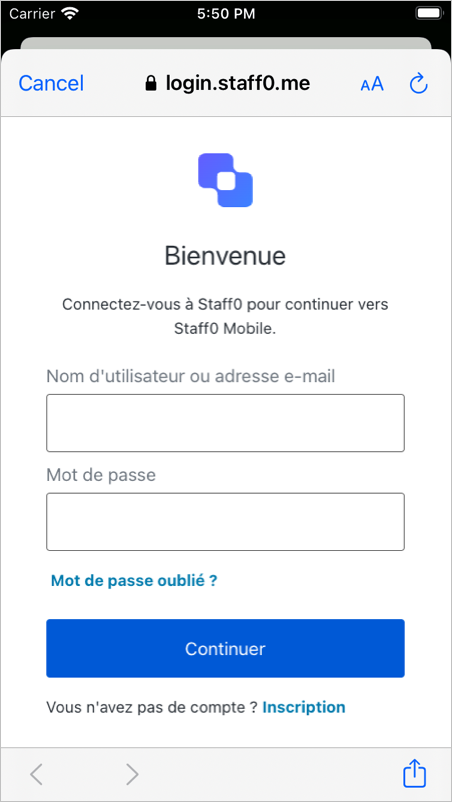
      Au préalable, vous devez fournir un moyen pour vos utilisateurs de se connecter. Nous recommandons d’utiliser la page de connexionhébergée par Auth0.

      <Frame>
        <img src="https://mintlify.s3.us-west-1.amazonaws.com/auth0-docs-event-stream-action-templates/docs/images/fr-ca/cdy7uua7fh8z/3ZRDXpjlUXEcQpXq6Q00L1/f3a4616c28881bbb5a3711fcbbf1f7b1/Staff0_Login_screen_-_French.png" alt="Un exemple d’écran de connexion universelle pour une application iOS." />
      </Frame>

      ### Configurer Android

      Ouvrez le fichier `build.gradle` dans le répertoire de votre application (généralement dans `android/app/build.gradle`) et ajoutez les placeholders du manifeste suivants. La valeur de `auth0Domain` doit contenir les paramètres de l’application Auth0 tels qu’ils sont configurés ci-dessus.

      ```
      android {
      defaultConfig {

          // Add the next line

          manifestPlaceholders = [auth0Domain: "{yourDomain}", auth0Scheme: "${applicationId}.auth0"]

      }

      ...

      }
      ```

      <Info>
        Au moment de l’exécution, la valeur `applicationId` se mettra automatiquement à jour avec le nom ou l’identifiant de package de votre application (p. ex., `com.example.app`). Vous pouvez modifier cette valeur à partir du fichier `build.gradle`. Vous pouvez également la vérifier en haut de votre fichier `AndroidManifest.xml`.
      </Info>

      ### Configurer iOS

      Dans le fichier `ios/<YOUR PROJECT>/AppDelegate.mm`, ajoutez ce qui suit :

      ```
      #import <React/RCTLinkingManager.h>

      (BOOL)application:(UIApplication *)app openURL:(NSURL *)url
            options:(NSDictionary<UIApplicationOpenURLOptionsKey, id> *)options

      {
      return [RCTLinkingManager application:app openURL:url options:options];
      }
      ```

      <Info>
        Ce fichier sera `ios//AppDelegate.m` pour les applications utilisant l’[ancienne architecture](https://reactnative.dev/docs/next/new-architecture-app-intro#ios---use-objective-c-mm-extension).
      </Info>

      Ensuite, ajoutez un URLScheme à l’aide de l’identifiant de l’ensemble de votre application.

      Dans le dossier `ios`, ouvrez le fichier `Info.plist` et localisez la valeur de `CFBundleIdentifier`.

      ```html theme={null}
      <key>CFBundleIdentifier</key>
      <string>$(PRODUCT_BUNDLE_IDENTIFIER)</string>
      ```

      Sous cette valeur, enregistrez une entrée de type URL en utilisant la valeur de `CFBundleIdentifier` comme valeur pour `CFBundleURLSchemes`.

      ```html theme={null}
      <key>CFBundleURLTypes</key>
      <array>
      <dict>
      <key>CFBundleTypeRole</key>
      <string>None</string>
      <key>CFBundleURLName</key>
      <string>auth0</string>
      <key>CFBundleURLSchemes</key>
      <array>
      <string>$(PRODUCT_BUNDLE_IDENTIFIER).auth0</string>
      </array>
      </dict>
      </array>
      ```

      <Info>
        Si votre application a été générée à l’aide de React Native CLI, la valeur par défaut de `$(PRODUCT\_BUNDLE\_IDENTIFIER)` correspond dynamiquement à `org.reactjs.native.example.$(PRODUCT\_NAME:rfc1034identifier)`. Pour l’application faisant office d’exemple, cette valeur correspond à `com.auth0samples`.
      </Info>

      Dans une étape ultérieure, vous utiliserez cette valeur pour définir les URL de rappel ci-dessous. Vous pouvez la modifier en utilisant XCode avec les étapes suivantes :

      * Ouvrez le fichier `ios/<YOUR PROJECT>.xcodeproj` ou exécutez `xed ios` dans un terminal depuis la racine de l’application.
      * Ouvrez l’onglet des paramètres de construction de votre projet ou de la cible souhaitée et recherchez la section contenant « Bundle Identifier » (Identifiant de l’ensemble).
      * Remplacez la valeur « Identifiant de l’ensemble » par le nom de l’identifiant de l’ensemble de votre application souhaitée.

      Pour des informations supplémentaires, veuillez consulter [la documentation de React Native](https://facebook.github.io/react-native/docs/linking).
    </Section>

    <Section id={sections[3].id} title={sections[3].title} stepNumber="4">
      L’appel `useAuth0` s’appuie sur un contexte React pour fournir une gestion d’état. Ce contexte est fourni par le composant `Auth0Provider`.

      Importer l’appel `useAuth0` et le composant `Auth0Provider` du package `react-native-auth0` :

      ```js theme={null}
      import {useAuth0, Auth0Provider} from 'react-native-auth0';
      ```

      Pour que la trousse SDK fonctionne correctement, vous devez envelopper votre application dans le composant `Auth0Provider` et définir les propriétés suivantes :

      * `domain` : Le domaine de votre locataire Auth0. En général, vous le trouvez dans Auth0 Dashboard sous vos paramètres d’application dans le champ Domain (Domaine). Si vous utilisez un domaine personnalisé, définissez-le plutôt sur la valeur de votre domaine personnalisé.
      * `clientId` : L’identificateur de l’application Auth0 que vous avez configurée précédemment dans ce guide rapide. Celui-ci figure dans Auth0 Dashboard, sous l’onglet des paramètres de votre application du champ ID client.

      <Note>
        ##### Point de contrôle

        Vous venez de configurer le composant `Auth0Provider`. Exécutez votre application pour vérifier que :
        la trousse SDK s’initialise correctement,
        votre application ne génère aucune erreur liée à Auth0.
      </Note>
    </Section>

    <Section id={sections[4].id} title={sections[4].title} stepNumber="5">
      Authentifiez l’utilisateur en appelant la méthode `authorize` fournie par le crochet `useAuth0`. Cette méthode redirige l’utilisateur vers la page Universal Login (Connexion universelle) Auth0 pour authentification, puis vers votre application.

      Pour confirmer que l’utilisateur a bien ouvert une session, vérifiez que la propriété `user` fournie par le hook n’est pas `null`.

      <Note>
        ##### Point de contrôle

        Ajoutez un bouton qui appelle `authorize` lorsqu’on clique dessus. Vérifiez que vous êtes redirigé vers la page de connexion, puis renvoyé vers votre application.
      </Note>
    </Section>

    <Section id={sections[5].id} title={sections[5].title} stepNumber="6">
      Pour déconnecter l’utilisateur, redirigez-le vers le point de terminaison de déconnexion Auth0 en appelant `clearSession`. Cette action supprimera la session de l’utilisateur du serveur d’autorisations et le déconnectera de l’application.

      <Note>
        ##### Point de contrôle

        Ajoutez un bouton qui appelle `clearSession` et observez si vous êtes redirigé vers le point de terminaison de déconnexion Auth0, puis renvoyé de nouveau. Vous ne devriez plus être connecté à votre application.
      </Note>
    </Section>

    <Section id={sections[6].id} title={sections[6].title} stepNumber="7">
      L’appel `useAuth0` expose un objet `user` qui contient des informations sur l’utilisateur authentifié. Vous pouvez utiliser cette option pour accéder aux informations décodées du profil utilisateur concernant l’utilisateur authentifié à partir du jeton d’ID.

      Si un utilisateur n’a pas été authentifié, cette propriété sera `null`.

      <Note>
        ##### Point de contrôle

        Connectez-vous et inspectez la propriété `user` sur le résultat. Vérifiez les informations de profil utilisateur actuel, telles que son `email` ou `name`.
      </Note>
    </Section>

    ## Étapes suivantes

    Beau travail! Si vous en êtes arrivé là, vous devriez avoir la connexion, la déconnexion et les informations de profil utilisateur actives dans votre application.

    Cela conclut notre tutoriel de démarrage rapide, mais il y a tellement plus à explorer. Pour en savoir plus sur ce que vous pouvez faire avec Auth0, consultez :

    * [Auth0 Dashboard](https://manage.auth0.com/#) : apprenez à configurer et gérer votre locataire et vos applications Auth0
    * [Trousse SDK react-native-auth0](https://github.com/auth0/react-native-auth0) : explorez en détail la trousse SDK utilisée dans ce tutoriel
    * [Auth0 Marketplace](https://marketplace.auth0.com/) : découvrez des intégrations que vous pouvez activer pour étendre les fonctionnalités d’Auth0
  </Content>

  <SideMenu sections={sections}>
    <SideMenuSectionItem id={sections[0].id}>
      <SignUpForm lang="fr" />
    </SideMenuSectionItem>

    <SideMenuSectionItem id={sections[1].id}>
      <SignUpForm lang="fr" />
    </SideMenuSectionItem>

    <SideMenuSectionItem id={sections[2].id}>
      <SignUpForm lang="fr" />
    </SideMenuSectionItem>

    <SideMenuSectionItem id={sections[3].id}>
      ```jsx app.js lines highlight={46-48} theme={null}
      import React from 'react';
      import {Button, Text, View, StyleSheet} from 'react-native';
      import {useAuth0, Auth0Provider} from 'react-native-auth0';

      const Home = () => {
        const {authorize, clearSession, user, error, isLoading} = useAuth0();

        const onLogin = async () => {
          try {
            await authorize();
          } catch (e) {
            console.log(e);
          }
        };

        const onLogout = async () => {
          try {
            await clearSession();
          } catch (e) {
            console.log('Log out cancelled');
          }
        };

        if (isLoading) {
          return <View style={styles.container}><Text>Loading</Text></View>;
        }

        const loggedIn = user !== undefined && user !== null;

        return (
          <View style={styles.container}>
            {loggedIn && <Text>You are logged in as {user.name}</Text>}
            {!loggedIn && <Text>You are not logged in</Text>}
            {error && <Text>{error.message}</Text>}

            <Button
              onPress={loggedIn ? onLogout : onLogin}
              title={loggedIn ? 'Log Out' : 'Log In'}
            />
          </View>
        );
      };

      const App = () => {
        return (
          <Auth0Provider domain={"{yourDomain}"} clientId={"{yourClientId}"}>
            <Home />
          </Auth0Provider>
        );
      };

      const styles = StyleSheet.create({
        container: {
          flex: 1,
          justifyContent: 'center',
          alignItems: 'center',
          backgroundColor: '#F5FCFF',
        }
      });

      export default App;
      ```
    </SideMenuSectionItem>

    <SideMenuSectionItem id={sections[4].id}>
      ```jsx app.js lines highlight={8-14} theme={null}
      import React from 'react';
      import {Button, Text, View, StyleSheet} from 'react-native';
      import {useAuth0, Auth0Provider} from 'react-native-auth0';

      const Home = () => {
        const {authorize, clearSession, user, error, isLoading} = useAuth0();

        const onLogin = async () => {
          try {
            await authorize();
          } catch (e) {
            console.log(e);
          }
        };

        const onLogout = async () => {
          try {
            await clearSession();
          } catch (e) {
            console.log('Log out cancelled');
          }
        };

        if (isLoading) {
          return <View style={styles.container}><Text>Loading</Text></View>;
        }

        const loggedIn = user !== undefined && user !== null;

        return (
          <View style={styles.container}>
            {loggedIn && <Text>You are logged in as {user.name}</Text>}
            {!loggedIn && <Text>You are not logged in</Text>}
            {error && <Text>{error.message}</Text>}

            <Button
              onPress={loggedIn ? onLogout : onLogin}
              title={loggedIn ? 'Log Out' : 'Log In'}
            />
          </View>
        );
      };

      const App = () => {
        return (
          <Auth0Provider domain={"{yourDomain}"} clientId={"{yourClientId}"}>
            <Home />
          </Auth0Provider>
        );
      };

      const styles = StyleSheet.create({
        container: {
          flex: 1,
          justifyContent: 'center',
          alignItems: 'center',
          backgroundColor: '#F5FCFF',
        }
      });

      export default App;
      ```
    </SideMenuSectionItem>

    <SideMenuSectionItem id={sections[5].id}>
      ```jsx app.js lines highlight={16-22} theme={null}
      import React from 'react';
      import {Button, Text, View, StyleSheet} from 'react-native';
      import {useAuth0, Auth0Provider} from 'react-native-auth0';

      const Home = () => {
        const {authorize, clearSession, user, error, isLoading} = useAuth0();

        const onLogin = async () => {
          try {
            await authorize();
          } catch (e) {
            console.log(e);
          }
        };

        const onLogout = async () => {
          try {
            await clearSession();
          } catch (e) {
            console.log('Log out cancelled');
          }
        };

        if (isLoading) {
          return <View style={styles.container}><Text>Loading</Text></View>;
        }

        const loggedIn = user !== undefined && user !== null;

        return (
          <View style={styles.container}>
            {loggedIn && <Text>You are logged in as {user.name}</Text>}
            {!loggedIn && <Text>You are not logged in</Text>}
            {error && <Text>{error.message}</Text>}

            <Button
              onPress={loggedIn ? onLogout : onLogin}
              title={loggedIn ? 'Log Out' : 'Log In'}
            />
          </View>
        );
      };

      const App = () => {
        return (
          <Auth0Provider domain={"{yourDomain}"} clientId={"{yourClientId}"}>
            <Home />
          </Auth0Provider>
        );
      };

      const styles = StyleSheet.create({
        container: {
          flex: 1,
          justifyContent: 'center',
          alignItems: 'center',
          backgroundColor: '#F5FCFF',
        }
      });

      export default App;
      ```
    </SideMenuSectionItem>

    <SideMenuSectionItem id={sections[6].id}>
      ```jsx app.js lines highlight={28-34} theme={null}
      import React from 'react';
      import {Button, Text, View, StyleSheet} from 'react-native';
      import {useAuth0, Auth0Provider} from 'react-native-auth0';

      const Home = () => {
        const {authorize, clearSession, user, error, isLoading} = useAuth0();

        const onLogin = async () => {
          try {
            await authorize();
          } catch (e) {
            console.log(e);
          }
        };

        const onLogout = async () => {
          try {
            await clearSession();
          } catch (e) {
            console.log('Log out cancelled');
          }
        };

        if (isLoading) {
          return <View style={styles.container}><Text>Loading</Text></View>;
        }

        const loggedIn = user !== undefined && user !== null;

        return (
          <View style={styles.container}>
            {loggedIn && <Text>You are logged in as {user.name}</Text>}
            {!loggedIn && <Text>You are not logged in</Text>}
            {error && <Text>{error.message}</Text>}

            <Button
              onPress={loggedIn ? onLogout : onLogin}
              title={loggedIn ? 'Log Out' : 'Log In'}
            />
          </View>
        );
      };

      const App = () => {
        return (
          <Auth0Provider domain={"{yourDomain}"} clientId={"{yourClientId}"}>
            <Home />
          </Auth0Provider>
        );
      };

      const styles = StyleSheet.create({
        container: {
          flex: 1,
          justifyContent: 'center',
          alignItems: 'center',
          backgroundColor: '#F5FCFF',
        }
      });

      export default App;
      ```
    </SideMenuSectionItem>
  </SideMenu>
</Recipe>